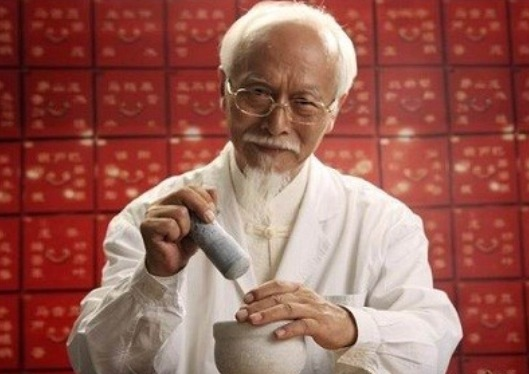





The doctor of traditional Chinese medicine experts
Unique Land Nurtures Unique Lives
In an article titled Who Can Save Traditional Chinese Medicine, Luo Shiwen, former Director of the Market Department of the State Food and Drug Administration, put forward a warning:
“For three to four years, we have followed a misguided route of ‘modernizing traditional Chinese medicine’ to align with international standards, which has accelerated the decline of TCM. If this trend persists for another five years, TCM will be irreparable.”
“Traditional medicinal herbs have long valued their native producing regions, known as genuine medicinal materials. This rule has been summed up through five thousand years of practical experience. A large number of tests have proven that once medicinal herbs are grown in a different environment, their medicinal potency will drastically decline.”
The emphasis on genuine native medicinal herbs is the core theme of this passage.
As information and finished products of noni gain rapid popularity, the market has seen a diverse range of brands. However, huge gaps in noni quality have emerged. All merchants tend to promote their products in ways favorable to themselves, leaving consumers unfamiliar with noni products at a disadvantage.
The fact that one product variant is high-quality does not mean all products of the same category are good.
Take rice, our staple food consumed for thousands of years, as an example: rice grown on industrially contaminated soil contains heavy metals; spoiled rice breeds lethal microorganisms; rice cultivated under different growing conditions carries vastly different nutritional compositions.
Traditional Chinese Medicine Will Perish Due to Degraded Chinese Medicinal Herbs
Professor Zhou Zhongying from Nanjing University of Chinese Medicine asserted: “Traditional Chinese Medicine will perish due to degraded Chinese medicinal raw materials.”
What has gone wrong with traditional Chinese medicinal herbs, the essence of China’s 5,000-year civilization?
Chinese medicinal herbs have always prioritized their native growing origins, known as authentic terroir medicinal materials. Director Luo Shiwen explained: “This rule has been summarized through five millennia of practical experience. Mass verification proves that once herbs are transplanted to unfamiliar environments, their medicinal potency will drastically decline.”
According to Director Luo, before the Cultural Revolution, any cross-region cultivation of medicinal herbs required three generations of trial planting to verify consistent efficacy. Farmers would sow seeds harvested from the first generation to grow the second batch, then reuse seeds from the second generation for the third batch. Transplantation was only permitted if the third-generation herbs delivered identical medicinal effects as the original native stock.
Nowadays, growers plant herbs arbitrarily anywhere they choose. Mass volumes of non-authentic herbs flood the market. The truth of excessive pesticide residues in herbal materials is even more alarming.
Medicinal herbs have merely become ordinary agricultural products. Growers only cultivate varieties that yield the highest profit, and adopt any cultivation methods that produce the largest, fastest-growing crops, regardless of herbal quality.
Noni origin
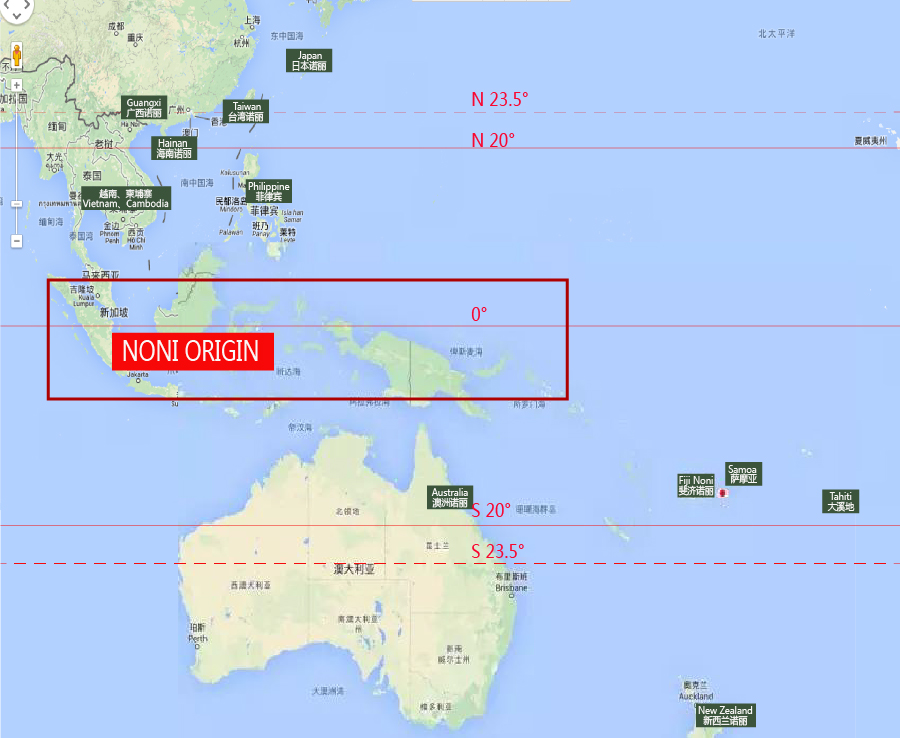
Noni Factory’s raw materials originate from the native homeland of noni: the equatorial region of Indonesia.
Differences in Noni Growing Environments
The optimal growing zone for noni lies within the South Pacific area spanning 10° North Latitude to 10° South Latitude along the equator.
Indonesia straddles both sides of the equator and is known worldwide as “Emerald on the Equator”. It is a paradise for plants and the native birthplace of noni.
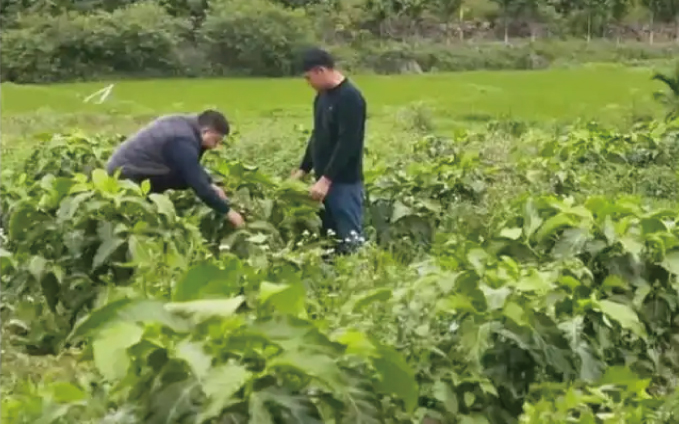
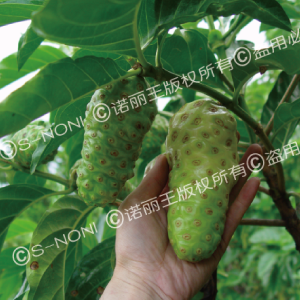
With an average annual temperature of 30°C and 70% humidity, local noni trees flourish with luxuriant foliage, blooming and bearing fruit all year round. The fruits are large, plump and juicy. No artificial fertilizers are applied in plantations. Furthermore, since noni trees often grow over 10 meters tall, pesticide spraying is impossible. This forms an entirely natural organic orchard.
Noni can also be found in other regions including the Philippines, Cambodia, Hainan Island and Taiwan Island. Restricted by various environmental and climatic conditions, these regions suffer drastic gaps in both output and fruit quality. Some plantations face environmental pollution or poor soil conditions that trigger genetic variation in noni fruits. Noni grown in these areas is usually unripe, tiny and hard, failing to develop premium quality.
Recently, many cultivators adopt modern agricultural techniques with heavy doses of hormones, chemical fertilizers and pesticides. Although such methods boost yields and enlarge fruit size, these forced cultivation practices carry numerous hidden safety hazards and cannot produce high-grade processed noni products.
This is analogous to transplanting ginseng from Northeast China to Hainan Island, or relocating coconut trees from Hainan to Northeast China.
Natural ecosystems follow inherent laws of growth and reproduction; human intervention cannot override nature.
As stated in The Book of Changes: The Dao means following nature; good fortune comes from complying with natural laws, while misfortune arises from acting against nature.
Many so-called modern agricultural improvements end up eliminating natural advantages. They destroy superior ecological conditions and degrade the inherent fine traits of plant species.
Comparison of Noni Growth Conditions from Different Origins
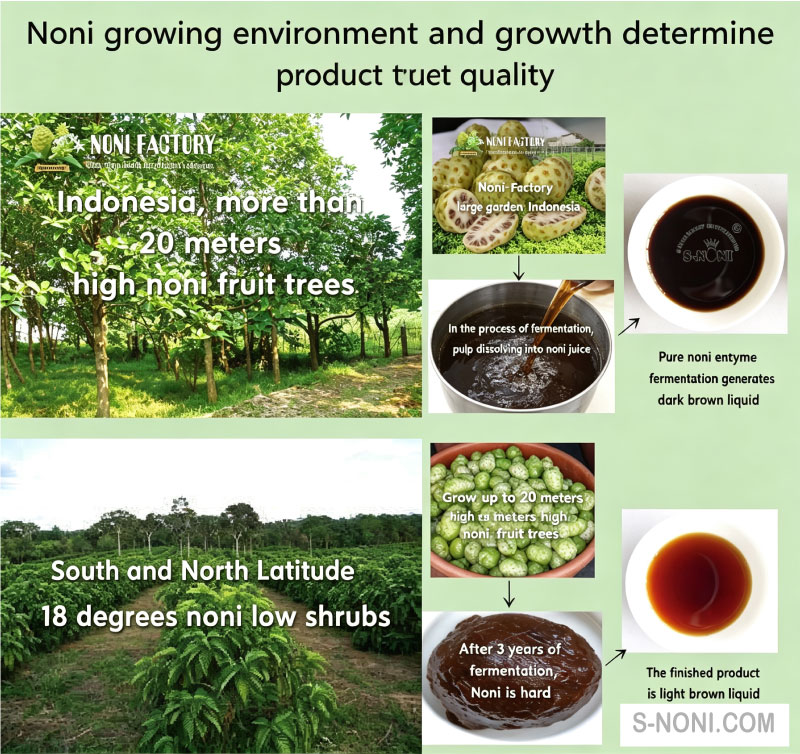
Noni originates in equatorial zones. The farther away from the equator the noni trees grow, the poorer the fruit quality. This contrast can be clearly verified via the comparison images below.

Indonesian noni trees grow near the equator (0°), reaching over 20 meters in height.

Indonesian noni fruits grown at the equator (0°), each reaching 14 cm in length
Noni from Taiwan, 23° North Latitude

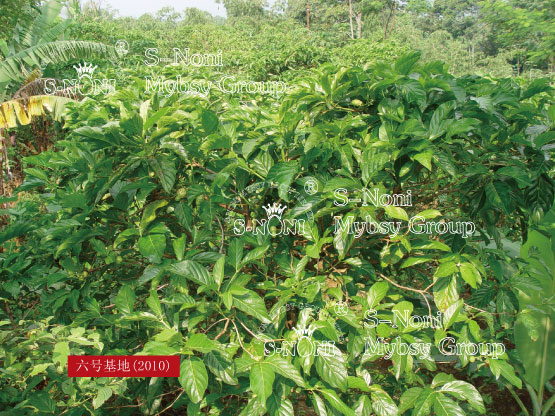
Noni trees at 23°N are low shrubs only around 3 meters tall

Noni fruits grown at 23°N are roughly egg-sized
Noni from Hai'an, China (20°N)

Noni trees growing at 20°N are low shrubs merely 3 meters tall.

Hai’an noni fruits cultivated at 20°N are less than 6 cm long and rarely ripen fully.
14° N -- Vietnam, Cambodia noni

Noni trees @ 14° N
3 meters below the low shrubs

Vietnam Noni fruit @ 14° N
Under 6 cm in length, grotesque noni
13° S - Samoa noni

Noni Trees (13°S)
Low shrubs, only 3 meters tall

Samoa Noni Fruits (13°S)
Less than 6 cm long, hard to reach full ripeness
17° South Latitude – Fiji & Tahiti Noni | FIJI NONI

Tahiti Noni Trees (17°S) Low shrubs, only 3 meters tall

Tahiti Noni Fruits (17°S)
Less than 6 cm long, hard to ripen fully
23° S - Australiai noni

Australian Noni Trees (23°S)
Low shrubs, only 3 meters tall

Australian Noni Fruits (23°S)
Egg-sized small fruits
Processing enzymes from underripe noni fruits produces a strong foul odor.
This explains why fermented noni enzymes from Indonesia feature a smooth, mild flavor.
By contrast, noni enzymes crafted from fruits grown farther from the equator carry increasingly pungent, putrid smells.
Noni goods produced in regions like Taiwan are often described as reeking of rotten cat carcasses.