Views:5,071
S-Noni production technology and quality
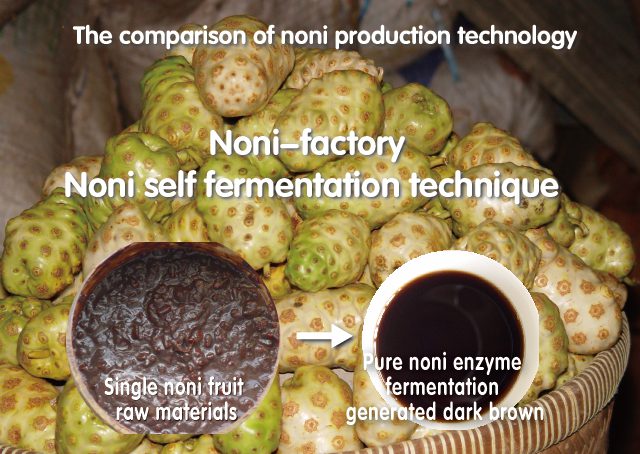
Classification of Noni Production Technologies
1. Our Pure Noni Self-Fermentation Process
Relying on the core proprietary technology — Noni Native Self-Fermentation Technology, the factory ferries whole hand-selected noni fruits. No external substances other than noni fruit are added throughout the whole production process under constant-temperature brewing conditions. The yeast strains used for fermentation are naturally generated by the noni fruit itself.
The production process consists of three fermentation cycles. Leveraging the inherent properties of fresh noni fruit, this additive-free self-active fermentation technique transforms the fruit’s raw substances and fully retains all original nutritional components of noni.
Produced in compliance with natural laws: following nature, returning to simplicity and stripping away unnecessary complicated processes, this brewing method maximally preserves the natural active ingredients inherent in raw noni fruits.

Noni production process classification
The quality of noni products hinges first and foremost on the origin of noni fruits. Inferior raw materials cannot be refined into premium products through any processing technique. Furthermore, high-quality noni fruits still require matching professional brewing technology to produce outstanding finished goods. Even premium noni raw materials fail to yield good products without proper craftsmanship; low-grade noni fruit paired with poor processing methods can never create high-quality goods. Therefore, do not blindly trust advertisements simply because a brand claims decades of production history. The logic is straightforward: fermenting garbage for a hundred years still results in garbage.
Why are Lafite Wine and Guizhou Moutai renowned worldwide? Why cannot Chinese wineries produce wine equivalent to Lafite’s standard? Why is authentic Moutai liquor exclusively produced in Guizhou, with no other regions capable of replicating its quality? This also explains the massive price gap within the same alcohol category: some bottles sell for tens or hundreds of yuan, while others cost tens of thousands or even hundreds of thousands of yuan.
Identical brewing techniques yield vastly different liquor quality when applied to raw materials grown in distinct environments or climates. For instance, genuine Guizhou Moutai can only be brewed within its unique native terroir. If Moutai’s production base were relocated from Guizhou to Hainan Island, reproducing authentic Moutai would be impossible.
This proves that the length of noni fermentation time is irrelevant. The decisive factor lies in the quality of noni raw materials. Premium noni raw materials paired with refined processing technology complement each other, and only native growing terroir can support the production of top-tier noni goods.
Noni quality can stand the test of long-term verification, yet numerous substandard noni products are falsely marketed as premium goods at inflated prices. Pricing becomes a misleading blind spot for consumers. Budget-conscious shoppers tend to compare prices and pick cheaper options from online marketplaces. Wealthier consumers often mistakenly assume higher prices equate to superior quality. This accounts for why certain blended noni juice brands are priced as high as ¥2,800 per 750 mL bottle.
Most consumers purchase noni products for health maintenance and physical conditioning, so extreme caution is required when selecting goods. Safety must be the top priority: buyers should avoid toxic noni contaminated with growth hormones, chemical fertilizers, heavy metals and excessive pesticide residues, before evaluating the product’s active nutritional compounds. Only by mastering the methods to identify genuine high-quality noni can consumers select suitable products and avoid commercial deception.
Noni self fermentation technique

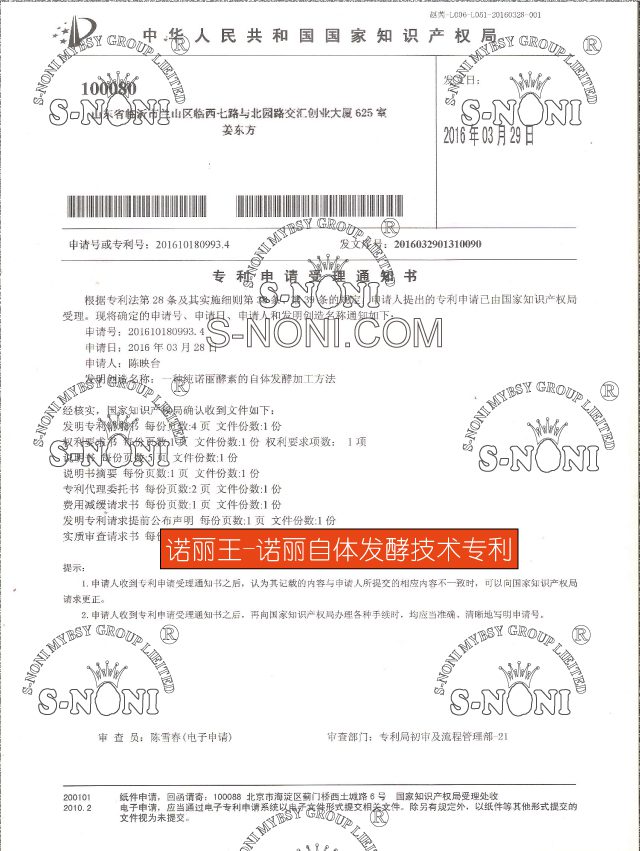
Noni factory invention of noni self fermentation technique
Self-Fermentation Processing Method for S-Noni Pure Noni Enzyme
This self-fermentation processing method for S-Noni Pure Noni Enzyme is characterized by the following specific operating procedures: Ripe Noni Fruits → Selection & Sorting → Cleaning → Drying → Roasting → Whole Fruit Barrel Packing → Primary Fermentation → Secondary Fermentation → Pressing → Filtrate → Stock Solution → Tertiary Fermentation → Sterilization → Filling → Capping → Bottle Inversion → Inspection → Spraying Cleaning → Inkjet Coding → Labeling → Shrink Wrapping → Packaging → Qualification Inspection → Finished Product → Third-Party Testing.
- In the drying step, cleaned noni fruits are hot-air dried via an electric hot air assembly line at 60°C.
- The roasting process subjects the dried noni fruits to instantaneous high-temperature treatment at 105°C for 3 seconds to thoroughly sterilize the fruit surface.
- For whole fruit barrel packing, the fully roasted and sterilized intact noni fruits are loaded into fermentation barrels.
- The primary fermentation adopts an anaerobic fermentation process: the fermentation barrel is kept under vacuum to carry out spontaneous fermentation of noni fruits at a constant temperature of 30℃ ~ 33℃.The barrels are turned over once every 8 days. When fermentation proceeds to the 90th day, nitrogen dioxide gas is injected at a proportion of 0.035% followed by barrel turning every 18 days.On the 144th day of fermentation, the process switches to aerobic fermentation to enter the secondary fermentation stage which lasts 180 days, with barrel turning still performed once every 18 days.The secondary fermentation is terminated when the pH value reaches 3 ± 0.2.
- The secondary fermentation is aerobic fermentation: pure oxygen is injected at a proportion of 3.8% every 6 days, so that the noni pulp is decomposed into liquid by endogenous yeast strains of the fruit itself.
- The tertiary fermentation steps are as follows:After pressing and 3 rounds of filtration to remove peel residues, the pure stock solution obtained from secondary fermentation is transferred into barrels for anaerobic ripening and fermentation in the tertiary stage, with a total fermentation duration of 49 days.Temperature adjustment schedule during this stage:
- Heat up by 10℃ on the 8th fermentation day;
- Heat up by 5℃ on the 15th fermentation day;
- Heat up by 5℃ on the 22nd fermentation day;
- Heat up by 5℃ on the 32nd fermentation day;
- Heat up by 10℃ on the 42nd fermentation day.The cumulative temperature increase brings the final temperature up to 65℃ upon completion of the 49-day tertiary fermentation cycle.
>>More>>Production Methods of Noni from Other Manufacturers